July 2025 edition · Neighborhood news
Pinwheels on Oak
The light turns green to cross Divisadero and three lanes of cars roar down Oak Street toward the highway.
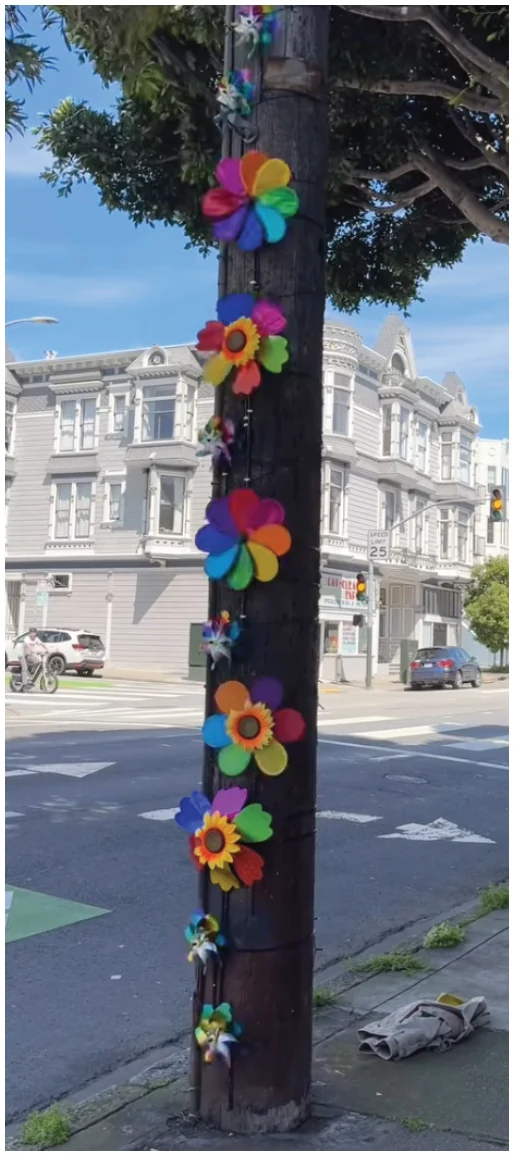
The light turns green to cross Divisadero and three lanes of cars roar down Oak Street toward the highway. As the bike lane disappears, cars turning right look anxiously for bikers. On the far corner lies a large abandoned gas station, ringed with fences. A permanently closed Kelly Moore sits on the other corner. But as of this Spring, bikers crossing Divisadero have been greeted by another sight: a tunnel of beautiful colored pinwheels lining the poles and trees lining the protected bike lane on the other side. This is the work of Jason Osborn, a 15-year resident of the block. Jason, an avid gardener, had a habit of filling the backyard of his apartment building with plants. Six months ago, he received a notice from his landlord (not a resident) that due to a rodent sighting, he needed to remove most of them.
“For me, honestly, I just had to figure out something to do with my garden. The area was bland, and I thought, you know what? If I can’t garden my backyard, why can’t I garden the block?” Jason started thinking of other ways to make the block nicer and ordered a few pinwheels, putting them on one of the utility poles. Right away, the response from neighbors walking by was positive. “Families would stop me and tell me how great this was. And they’d bring their kids down there every morning, telling me how happy it made them.” So he kept going, ordering pinwheels from Amazon, funding the whole operation from his personal savings. Pinwheels always disappeared, and Jason was never sure why. The wind? A neighbor? The city? As he spent days (and often quiet evenings) out on the block, Jason met more neighbors than he had in 15 years. “I’ve talked to so many people on the street. I’ve had probably three people give me 20 bucks for my pinwheel fund.” Someone posted on the San Francisco subreddit online: “Bless Whomever Placed these magical Pinwheels on the Wiggle.” The post drew enthusiastic responses: “I love how they’re lined down the block!!! So fun to add some sparkly whimsy to the world” and “A much needed pop of color at that busy intersection. Thank you pinwheeler!” Randomly, a neighbor delivered him a gift basket with a note about how much the pinwheels had meant to them. “I want it to be a block of just fun. I want it to be more like a botanical garden or a sparkle when you come through there.”
I interviewed Jason on Friday June 13th. A few days later on June 16th, Jason called to tell me that most of his pinwheels were removed - and that he suspected the city. Working with Molly Hayden (another concerned neighbor) and Jason, we reached out to the office of the District 5 Supervisor, Bilal Mahmood, to see if his office could help figure out what had happened. Mahmood’s office was extremely responsive and helpful. They confirmed: “Public Works […] confirmed that it was their team who removed the pinwheels that were closer to the street. They shared that they received [a] number of requests from nearby residents concerned the installation was distracting to drivers, which led to their removal.” To my mind, this update is the perfect encapsulation of the complexity of cities. Who are cities for? Do we cater to the drive-by complaint of someone on Oak street, when there are far more neighbors who love the pinwheels? Not to mention, the safety concern of ‘distracting drivers’ is far-fetched. How do we as a city and as neighbors make it easy or hard for neighbors to engage with their community and make life better for those around them? I want to support and connect anyone who wants to contribute to our city, the central ethos of this paper. If you like Jason’s project, you can (1) follow him on Instagram @wigglewheelssf, (2) be loud about supporting neighbors who take their time and money to make our neighborhood beautiful, or (3) start your own project and get your neighbors involved!
Jason disputes that his plants, or any potted plants for that matter, are a reasonable root cause of a single rodent sighting.