September 2026 edition · History
The Old Spanish Road (Devisadero)
The most direct route between the Mission and the Presidio was, for the first century of their existence, referred to by residents using the name Sans Souci Valley.
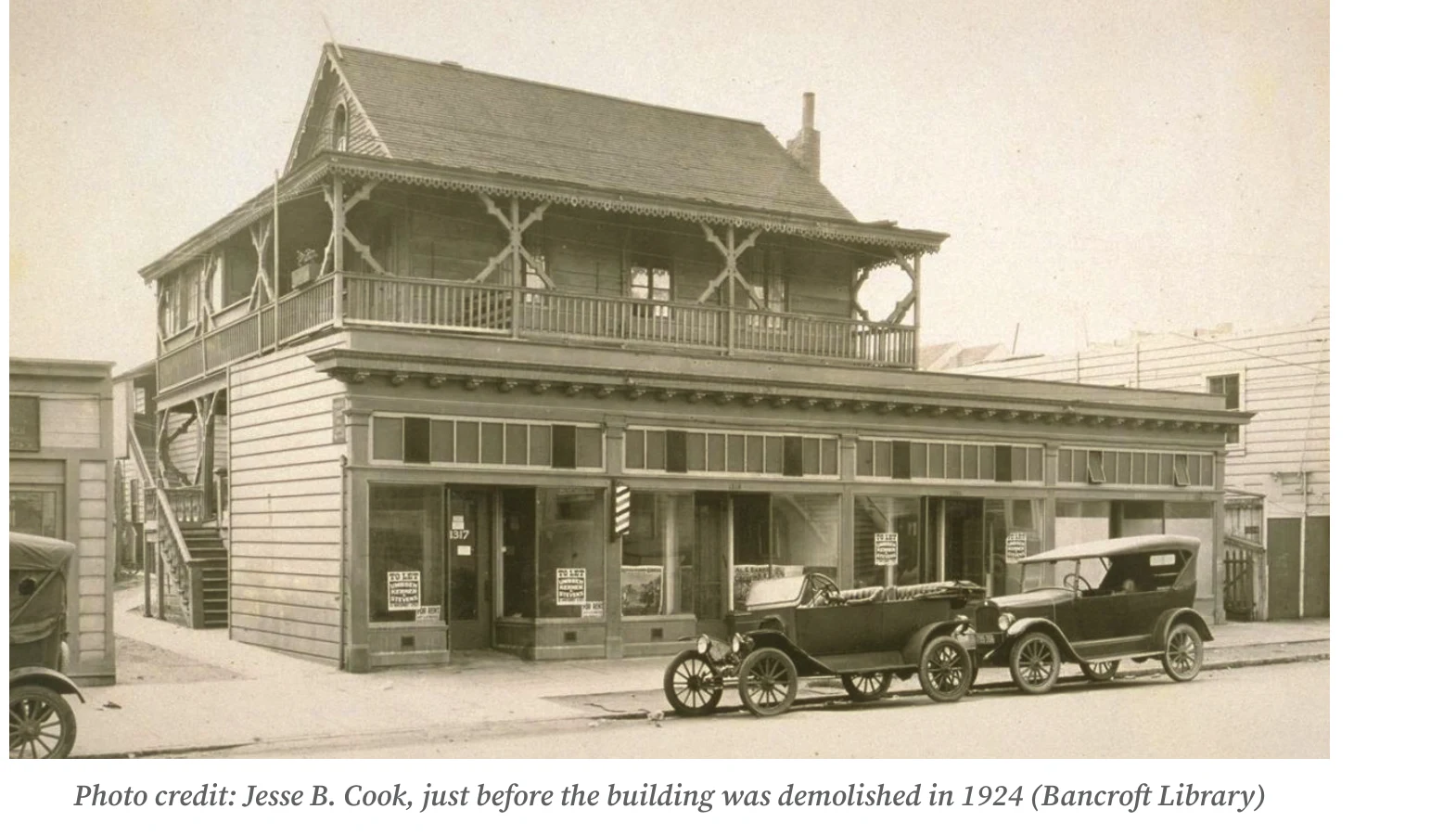
The most direct route between the Mission and the Presidio was, for the first century of their existence, referred to by residents using the name Sans Souci Valley. It was seen as a valley thanks to the prominent hills (now gone) near the mission end of that route. Together with Buena Vista Hill, they formed a gateway, with the cluster of old buildings that was Mission Dolores framed by this entryway up into the hills.
‘Sans souci’ is French for care-free, a possibly-intentional juxtaposition to ‘dolores’—Spanish for sorrow or pain. It was named after an establishment along the way, a roadhouse and minor resort where people could get a drink, go hunting, or just take a rest on their slog through the dunes. With streets added around the building, Sans Souci Road House became 1317 Fulton Street, just west of Divisadero Street. Storefronts were added, extending it forward to the sidewalk.
For thousands of years, the bottom of this valley, now gridded and known as the Wiggle, was the main route through the vast dune field. Avoiding the highest hills, it was the link between two Yelamu settlements: Chutchui, adjacent to the Mission, and Petlenuc, on a salt marsh at Crissy Field along the north edge of San Francisco.
As a street system was being mapped out, the snaking route through these hills was still called the Old Spanish Road or the Devisadero Road. Devisadero (the old spelling) was a Spanish term meaning lookout or viewpoint. Heading north, it crested Pacific Heights. There, a breath-taking view of the bay was your reward for overcoming the incessant sand. During the early years of the city, there was a little gazebo up top, later a water tank, and eventually a private home at the northeast corner of Pacific Avenue and Lyon Street.
The prominent street approximating the old road was likewise named Devisadero. By sheer chance, this street was the last one westward within the boundaries of the 1851 city limits, so it called up thoughts of a dividing line. This coincidence pushed a gradual shift in spelling conventions to ‘Divisadero’, a nonsense word that conveniently evokes a divide.
The chaparral (scrubby plants) and blowing sand, west of the 1851 line, was known as the ‘outside lands’—the origin of that term.
Consider also the arduous journey from the Presidio back to our neighborhood, mid 1800s, when the Devisadero Road wound its way through. Heading south, we would cross a mile of chaparral between Pac Heights and Fulton street, trending east toward Scott Street to skirt Anza Vista. (A hunk of that hill was removed at Turk Street to straighten Devisadero.) Coming back west from that little detour, we would go over the lowest point in the ridge at McAllister and Divisadero, past the Sans Souci.
In the 1860s, after the extreme winter of 1861–1862 saturated the dunes and made ponds, one formed at the roadhouse that attracted ducks (for hunting, by the sentiment of the time).
Keeping Sans Souci to the right as we head south, we’d descend past the ridge on the left with its multiple hilltops, the first being Alamo Square. On the right, the main hills of the city: Buena Vista on up, to Twin Peaks.
At today’s Scott Street and Hayes, the road passed through a linear dune through a notch, shown in Emily Underwood’s illustration. One last linear east-west dune needed to be crossed at Page Street. At Fillmore the notch in this dune allowed, finally, a view of the Mission, as seen in last month’s issue.